Free Claude skill
Is your setup hobbling Opus 5?
Anthropic deleted 80% of Claude Code's own system prompt for this generation. This skill finds the same dead weight in your CLAUDE.md, your rules and your skills, and grades what it finds.
Instant download. I will never spam you.
Five things changed with the Claude 5 generation
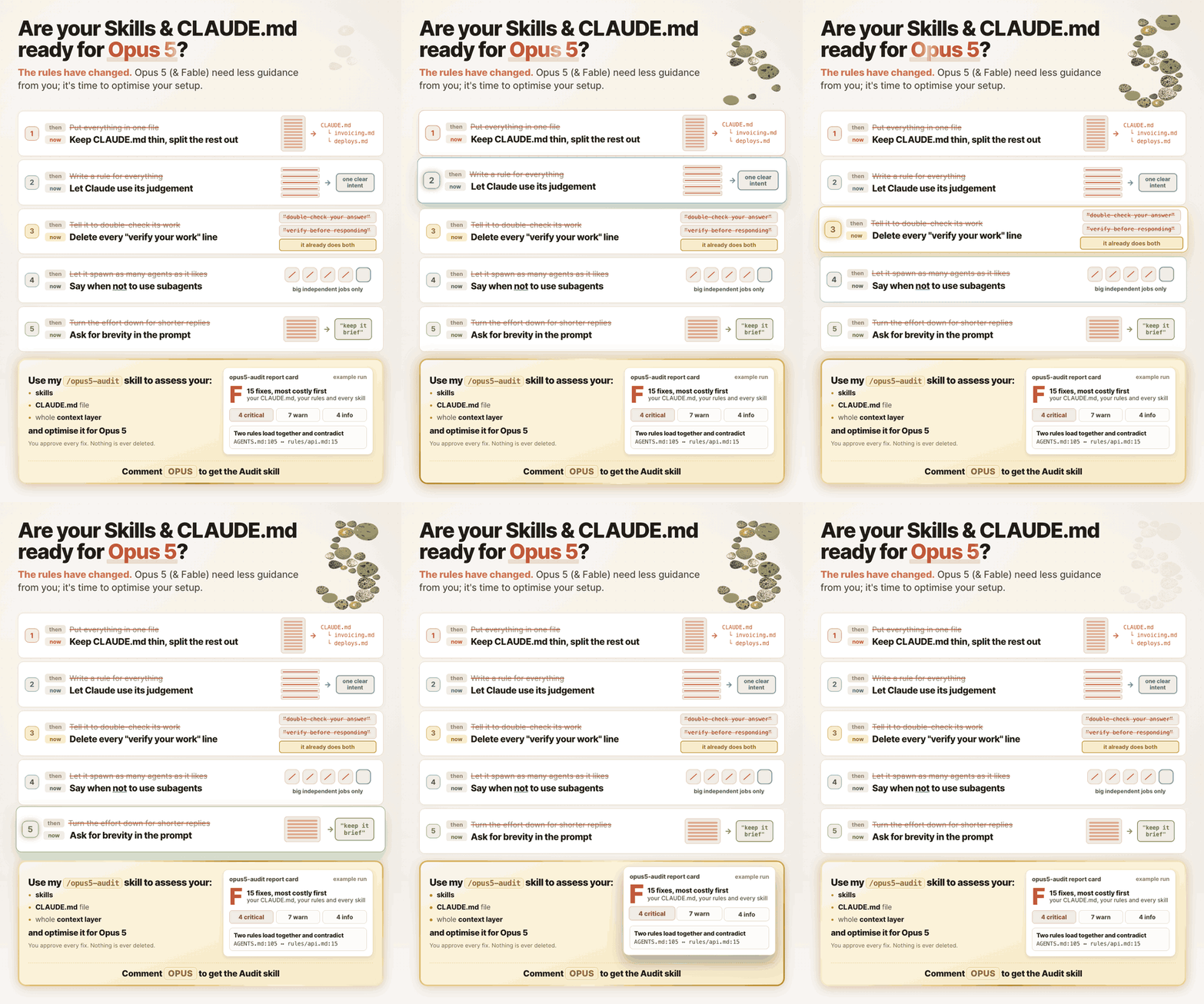
Most CLAUDE.md files, rules and skills were written for an older model, and they still carry the weight that model needed. Anthropic has documented what moved. Here is each change with the line behind it, and the audit checks your setup against all five, quoting the same sources back to you.
- 1Put everything in one file
Keep CLAUDE.md thin, split the rest out
A CLAUDE.md that grew into a manual is read in full on every single request, whether the task needs it or not. The move is a thin main file plus a tree of smaller ones Claude opens only when the work calls for them.
Keep your CLAUDE.md lightweight and briefly describe what your repo is for, but spend most of the tokens on gotchas inside of the codebase.
Anthropic, the new rules of context engineering for Claude 5 models - 2Write a rule for everything
Let Claude use its judgement
Most rules in an older setup exist to stop a worst case that these models no longer hit. Left in place, they force Claude to reconcile instructions that contradict each other before it can start the actual task.
we have since found we can delete many of them and let the model use surrounding context and judgement instead.
Anthropic, the new rules of context engineering for Claude 5 models - 3Tell it to double-check its work
Delete every "verify your work" line
Opus 5 verifies its own work without being asked. Telling it to do so again compounds with the behaviour it already has, so you pay for the same checking twice.
Avoid instructing re-checks it already performs ("double-check your answer," "re-verify before responding")... these compound with the model's own behavior and add cost without improving results.
Anthropic, prompting guide for Claude Opus 5 - 4Let it spawn as many agents as it likes
Say when not to use subagents
Delegation is worth it on genuinely independent tracks of work and expensive on everything else. The fix is to say which jobs justify it, or cap how many can be launched.
Claude Opus 5 delegates to subagents more readily than prior models.
Anthropic, prompting guide for Claude Opus 5 - 5Turn the effort down for shorter replies
Ask for brevity in the prompt
The effort setting governs how much the model thinks rather than how much it says, so turning it down will not reliably shorten anything. If the answers feel long, say so in your instructions instead.
lowering effort can reduce thinking volume without reliably shortening the visible response. To control response length, prompt for it explicitly.
Anthropic, prompting guide for Claude Opus 5
What it gives you
- A grade, A to F, and every finding ranked by what it is costing you
- Each one quotes the Anthropic sentence behind it, with the link, so you can check my working
- What to add, as well as what to cut. These models want things older setups never had to give them
- A report card written to your own machine, as a standalone HTML file you keep
It proposes; you approve each fix. Nothing is ever deleted: removed content is moved to a backup folder with a manifest, so any change can be undone. Nothing leaves your machine, and it never reads your .env files.
Built from
- Anthropic's prompting guide for Claude Opus 5
- The Claude 5 context-engineering post by Anthropic technical staff
- Anthropic's own skills and Cowork documentation
Graded checks are Anthropic-only. Anything that needed my own opinion ships as a labelled suggestion and is excluded from the grade.
Very few people can explain and teach AI in a way that is accessible, clear and fun. James is one of those rare few.
Everything I needed: no filler, deeply interactive, and he clearly knows this space inside out.
James had us building a personal AI coach in an hour. It opened my eyes to what is possible.
Ready when you are
Drop your email and the download unlocks right here, instantly.
Instant download. I will never spam you.
Questions people ask before running it
What does the Opus 5 audit actually check?
Your CLAUDE.md and AGENTS.md files, any files they import, the rules folders alongside them, and every SKILL.md the session can see. It reports contradictions between instructions that load together, instructions Claude 5 models no longer need, guidance that now works against them, and the things these models want that your setup does not have yet. Settings, hooks and MCP configuration are deliberately out of scope: it never reads or changes them.
Does it work in Cowork, or only Claude Code?
Both. Cowork reads and edits the files in your working folders, including CLAUDE.md and any skills stored there, so the full audit runs. The one thing out of reach is a skill that exists only in your Cowork account with no local file, and the report says so rather than pretending otherwise.
Will it delete anything?
No. It proposes, you approve each change, and nothing is deleted: removed content moves to a backup folder with a manifest so any change can be undone. It also never reads .env files or anything credential-shaped.
Does my code or context get sent anywhere?
No. The audit runs in your own session on your own machine, and the report card is written to a local HTML file. There is no telemetry and nothing to phone home to.
My setup is quite lean already. Is it worth running?
Yes, because a clean run is not an empty one. If there is nothing to prune you get an A grade, the list of what was checked and why it passed, and the recommended additions: the instructions the Claude 5 generation responds to that older setups never needed.
How is this different from /doctor?
Anthropic's /doctor covers installation health, invalid settings, unused extensions and CLAUDE.md content it can derive for you, and it is Claude Code only. This audit covers what that does not: the quality of the instructions inside the files you actively use, the skills themselves, and how your folders are organised, in Cowork as well as Code.
Want the ongoing habit rather than the one-off audit? The weekly workspace review skill audits your setup every Friday.
Want to build agents with me live?
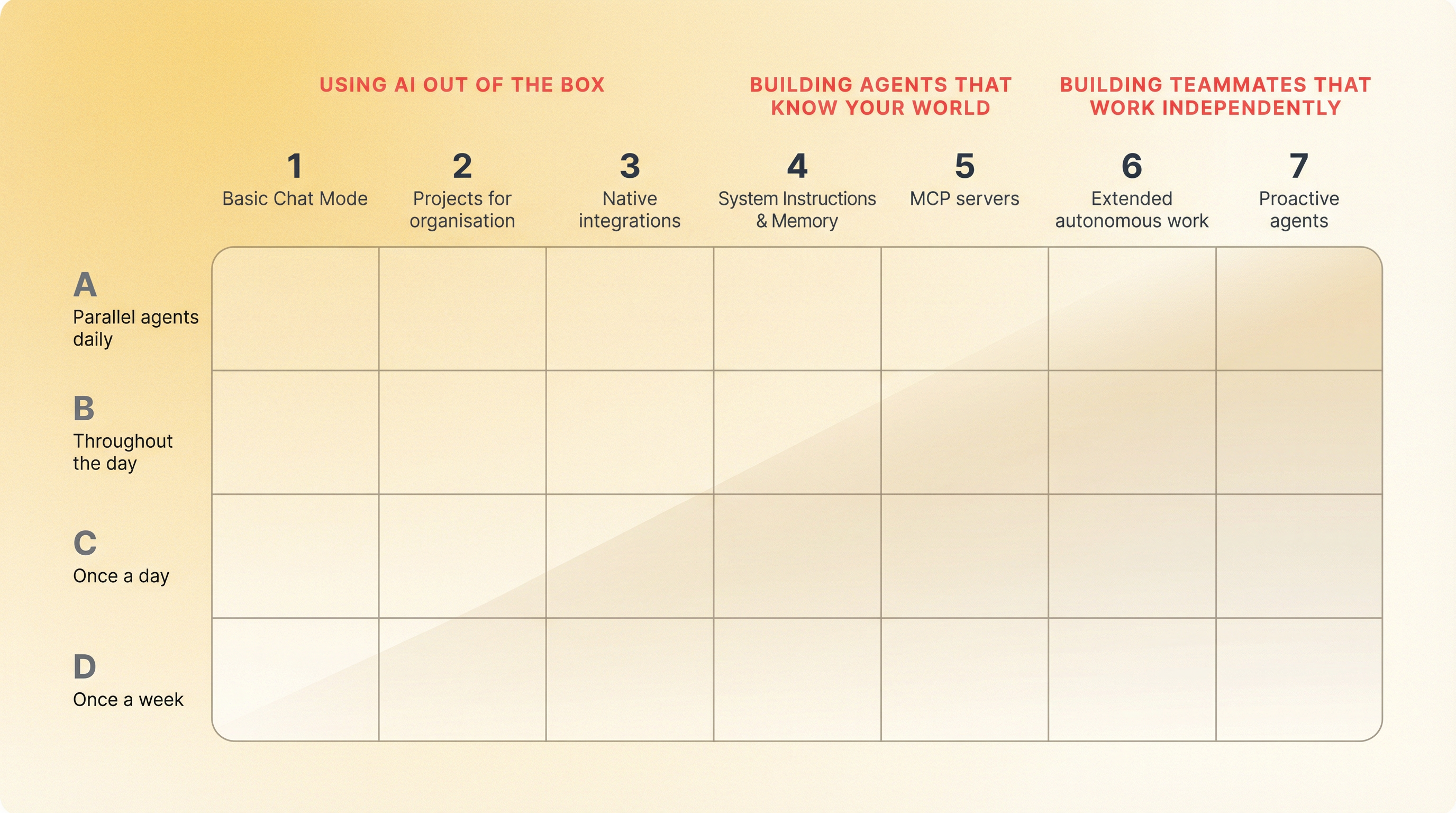
The workshop showed you what's possible. The accelerator is where you actually build it. Eight chapters over four weeks, live sessions, office hours with your function peers, guest speakers, and a Demo Day at the end.
Agent Foundations
Build your first agent and leave with it actually running. A Strategy Agent trained on your background, your goals, and how you think.
Security
Learn what can go wrong with agents before something does. Prompt injection, permissions, blast radius — and how to set sensible limits from the start.
Integrations & MCP
Connect your agent to live data and the tools you already use. Your AI knows your pipeline now. It can act on it.
Skills
Package the things you keep doing into reusable workflows. Trigger them with a word. Share them with your team.
Proactive Agents
Build agents that run while you're not watching. Scheduled briefings, overnight research, alerts that fire when something changes.
Team Agents
Get the rest of your team using this stuff. Share agents, share skills, share context. Stop being the only one who benefits.
Coding Agents
Give an AI a brief and watch it write working software. No coding experience needed. Ship something real.
Demo Day
Show the cohort what you built. See what everyone else made. It's usually the best session of the four weeks.
Join the Agent Accelerator. Four weeks, live with James and a cohort of founders and operators who are actually doing this.
Cohort 4 kicks off Tuesday 29 September 2026
Learn more about the Accelerator