
Every UK adult can take free AI courses through the government's AI Skills Hub, some in under 20 minutes, and earn a foundations badge. Ask your whole team to take one. They teach the basics of using AI tools, such as writing prompts and spotting risks. They stop short of building agents that do your team's work, which takes hands-on training on real tasks, with follow-up after it.
James McAulay has trained 700+ people from 250+ companies to build AI agents. Four weeks after starting, people who had mostly used AI as a chatbot are now able to demonstrate agents doing real jobs, such as the one a COO at Connectd built to turn Notion roadmap pages into a stakeholder deck. Many of them weren't technical when they began.
Who can take the free government AI training?
Any adult in the UK. The courses come from industry partners such as Google, Microsoft, IBM, Sage and Salesforce under the government's AI Skills Boost programme, which had delivered 1.7 million courses by April 2026.
| The free government AI courses | The details |
|---|---|
| Cost of the AI Skills Hub courses | Free |
| Length of a free AI course | Some take under 20 minutes |
| What you get for finishing | A virtual AI foundations badge |
| The government's AI skills target | 10 million workers trained by 2030 |
How do you sign up for the free AI courses?
Create an account on the AI Skills Hub, then open AI Skills Boost. You can build a personalised learning path there or browse the full catalogue. Ask your team to choose a course that awards the foundations badge, so everyone ends up with the same basics.
Is the AI Skills Hub worth it for a team?
Yes. It's free and quick. If your team only needs to write better prompts and use AI tools safely, it may be all you need. If you want agents doing work for your team, it's where you start.
What does the AI foundations badge prove?
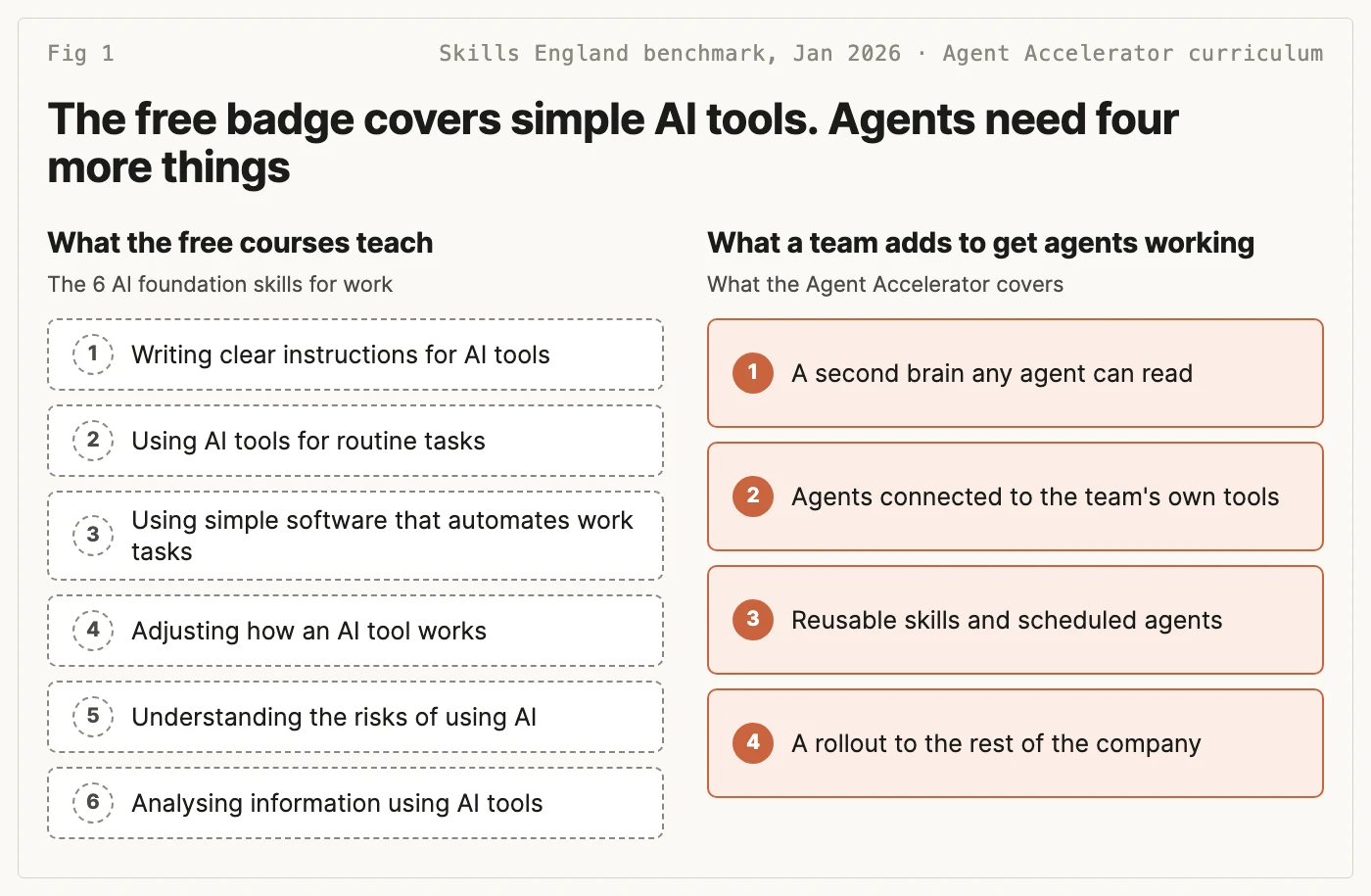
It shows someone has finished a course covering the basics of using simple AI tools. The government says the badge helps employers know that workers "can use simple AI tools in a safe, effective and responsible way". To award it, a course has to cover all six skills in Skills England's AI foundation skills for work benchmark:
- writing clear instructions for AI tools
- using AI tools to support routine processes and tasks
- using simple software that automates work tasks
- adjusting how an AI tool works to get better results
- understanding the risks and consequences of using AI
- analysing information using AI tools
The benchmark's own examples are drafting messages, organising information and sending reminders. So this is basic prompting and simple automation.
None of the six skills in the benchmark is about building an agent. A team that wants agents doing its work has to add four more things, which James's Agent Accelerator covers:
- a second brain: the team's context kept in files any agent can read, so nobody pastes the same background into a new chat each morning
- agents connected to the team's own tools, so one can read a thread in Gmail and check the deal in HubSpot before it drafts a reply
- reusable skills and scheduled agents, which run a job the same way every time without anyone starting it
- a rollout to the rest of the company, to get what the first builders make used beyond them
Why isn't a free AI foundation course enough to build agents?
Using AI every day and having agents do the work are different goals. An agent that drafts the weekly report, chases unpaid invoices or sorts the support inbox has to be built: someone gives it the team's context, connects it to the tools it needs, tests it on real cases and fixes it when it breaks. A short online module isn't built to teach that.
The government's own research points the same way. Its 2026 reports say AI training works when it's practical and tied to real tasks, and that limited AI skills still affect two in three businesses that have adopted AI:
| Government source | What it says |
|---|---|
| What works for AI upskilling, 2026 | "Good AI training must be practical and task based." |
| The same report | AI skills "should not be approached as a one-off course or a simple tool demonstration." |
| AI adoption survey, 2026 | Limited AI skills, expertise or knowledge affected 67% of businesses that had adopted AI. |
James's graduates talk about the step up from prompting too. Martin Leguay, CEO of Touchnote, called the course a way to get "from simple prompting to building a structured way of leveraging Claude across the team & tools". Leslie McArdle, VP Marketing at VitaMojo, said: "I've done a number of AI courses but this one has been the most hands on and practical".
How should a team use the free government AI courses?
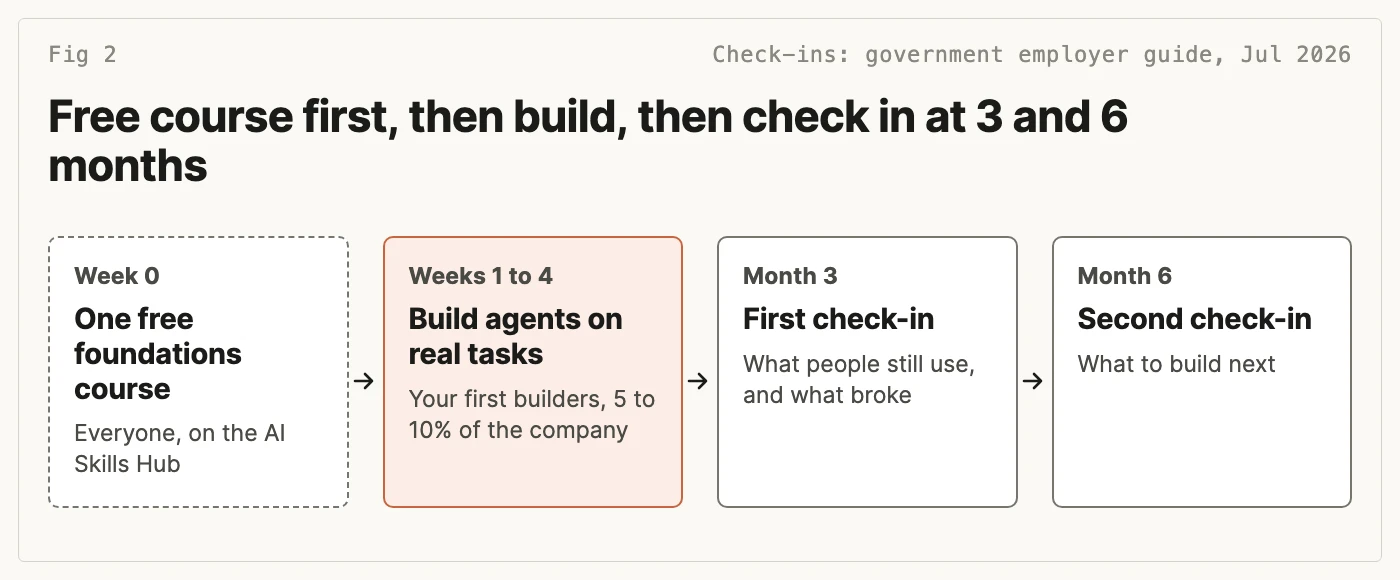
Make the free course week zero of your AI rollout, then spend your training budget on a more practical, hands-on agent course that goes beyond the government basics.
- Everyone takes one free course before any paid training starts, so live sessions can begin with real work.
- Pick your first builders. These are the AI champions who'll build agents for themselves and for colleagues. James's guide to Claude budgets suggests starting with 5 to 10% of the company and choosing by what people already do, not by job title.
- Build on real tasks, live. Each person builds agents for jobs they'd otherwise do by hand, with someone there to help.
- Book protected time. The employer guide on gov.uk says learners should get paid or protected time to take part, so put the sessions in the diary instead of fitting them around the day job.
- Check in at three and six months. The employer guide says going back to training after 3 and 6 months can help staff reflect on how they use AI. Ask what they still use and what broke.
BCG found regular AI use is "sharply higher" for people who get at least five hours of training, plus access to in-person training and coaching.
What do teams build after hands-on AI agent training?
Everyone leaves James's cohorts and workshops with agents getting work done for them. Graduates who answered the end-of-course form report saving a median of 5 hours a week, and you can read every review. Some of what teams have built:
- At Huggg, Mustafa, an account executive, finished a two-day bootcamp with an agent connected to his Gmail, HubSpot, Slack and calendar. "It's like I've got my own sales assistant working alongside me", he said. Paul Wickers, Huggg's CEO, said: "It's probably the highest ROI thing I've done since the day I founded the company." Read the Huggg case study.
- At Connectd, Jamie wired HubSpot to Slack, so six account managers get their list of leads to chase every morning. Read the Connectd case study.
- At Koru Kids, CEO Rachel Carrell said her team went "from never really having done much of this stuff at all" to "building their own apps" in four weeks. Read the Koru Kids case study.
Sarah Pearson, who works in operations at Supercede, said the course took her "from AI novice to someone using Claude Code to build complex solutions and autonomous agents in 4 weeks (and I have no technical background)."
What do teams ask before booking AI agent training?
Does it work if our company only uses Copilot or ChatGPT?
Yes. James's course and workshops work in Claude, ChatGPT or Microsoft Copilot. Say which one your team uses on the scoping call and he'll run it there.
Do people need to be technical to build AI agents?
No, and nobody needs to code. Every workshop assumes no technical knowledge, and agents are built by describing what you want in plain English.
Is it safe to connect AI agents to our company tools?
Yes, if you start read-only. Security and permissions are part of the foundations James teaches, and people connect an agent to their own tools read-only first, the way you'd onboard a new hire.
What happens after the training ends?
Your team gets a written roadmap of what to build next and how, so it can keep building without James. You can add access to the learning platform, and private coaching calls with James and his coaches are available if you want more help.
Book a private AI agent workshop for your UK team
Once your team has the basics from the free course, a private workshop gets each person building agents on their own work, live with James. James can run any length for any size of group. He recommends in person where you can, because the change is bigger and faster with everyone in the room.
| Length of workshop | What your team does |
|---|---|
| Half a day | Each person connects one tool and builds one agent |
| One day | Set-up in the morning, agents working for each person by the afternoon, demos to close |
| Two days | The second day adds agents that run on a schedule, with no one needing to start them |
You can read more about private AI training for UK teams, and people who want to go further can take the four-week Agent Accelerator. To start, book the 20-minute scoping call below: James will tell you which length fits, then send a quote.
Tagged: uk-ai-training, government-ai-training, team-rollout