The 9 Claude skills I actually use
9 skills I run most weeks, in Claude Cowork and Claude Code. What each one does, when I use it, and how to install it so it actually loads.
Last updated 18 September 2026
Which one do you need?
- set-up-my-second-brainA 20-minute interview that writes down your role, goals and how you work, so every answer after it fits you
- prdFind the flaw in your plan before you spend a week building it
- multi-agent-refineSends your draft to several critic agents that try to break it, then fixes what they find
- weekly-retroPulls your week together every Friday and ranks what to do next, so Monday starts with a short list
- opus5-auditGrades your CLAUDE.md and skills against Anthropic's own guidance and cuts what is slowing Claude down
- stop-wasting-tokensAudits your Claude setup and makes ten of the fifteen token-saving changes for you
- linkedin-infographicTurns one idea into a finished LinkedIn graphic, PNG or GIF, checked against 15 rules before you see it
- weekly-workspace-reviewReads your whole setup once a week and reports what to fix, archive or merge, in a dated file you can compare
- crystallise-memoryCopies everything Claude has quietly learned about you into plain files you can read, edit and keep
What is a Claude skill?
A skill is a folder with a SKILL.md file inside it. The file teaches Claude how to do one job properly: what to ask you first, and what good looks like when it's done. Claude only reads the full instructions when that job comes up, so a shelf of twenty skills costs you a line of description each until one is needed. You don't need to write any code to make one.
The 9 skills
Grouped by where they fit in the journey. Five of them arrive together as one download, so those rows all point at the same page.
Foundations
Set up once. Every other skill on this page works better after this one, which is why it goes first.

Doing the work
For the days you are building or shipping something that matters.
 /prdskillWrite the brief before you buildInterviews you about a rough idea and turns it into a brief: the problem, the decisions you've made, the constraints, and milestones you can tick off as you go.Most AI builds go sideways because the spec only ever lived in your head. This drags it out and hands the build agent something to follow, so you get the thing you meant rather than the thing it guessed.
 /multi-agent-refineskillSend your work to a panel of criticsSpins up several critic agents with genuinely different angles, has each one try to break your work, then fixes what they find. It runs up to three rounds and stops early if a round comes back clean.A single AI reviewer mostly agrees with you. Several sceptical ones will find the thing that would have embarrassed you, while there's still time to fix it.
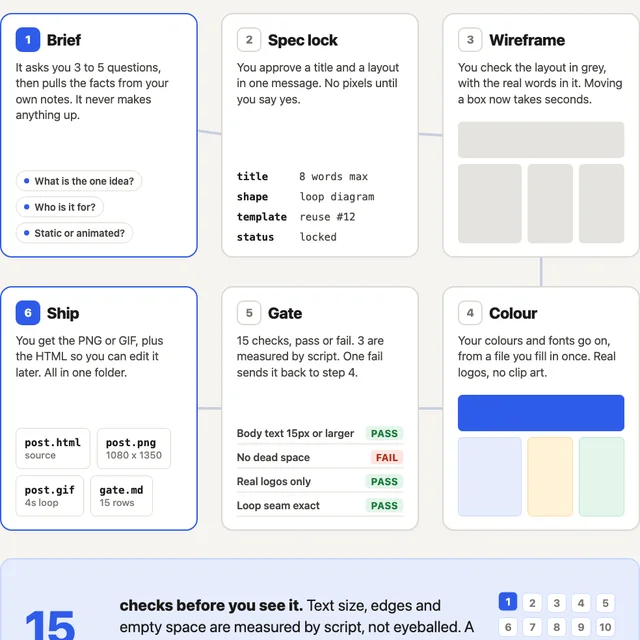 /linkedin-infographicskillTurn one idea into a LinkedIn infographicAsks you 3 to 5 questions, agrees a layout, wireframes it in grey, then colours it from a brand file you fill in once. 15 checks run before you see anything. Static PNG or a seamless looping GIF, with the source HTML beside it.It made every graphic on my feed this summer, including the one that drew 225 comments. 3 of the checks are measured by script, so dead space and tiny text never reach you.
The weekly rhythm
The Friday loop: review the week honestly, then make the review run itself.
 /weekly-retroskillPull the week together and rank what is nextWalks you through an end-of-week review: what actually happened, what you committed to last week, and what earns your time next week. It'll pull real numbers in too if you've connected your calendar or task list.Nobody reviews their own week honestly from memory. Getting asked the same awkward questions every Friday is the point.
 /weekly-workspace-reviewskillA weekly audit of your whole setup, rankedOnce a week it reads your skills, context files, connectors and folder structure, then reports what your setup keeps getting wrong: the outputs you never act on, the fixes you make by hand every time, the same note saved twice under two names. It archives rather than deletes.Setup maintenance is the thing everyone puts off, so it rots quietly. It writes a dated report each week, so you can see whether yours is actually getting better.
Housekeeping
Occasional deep cleans for the setup itself.
 /opus5-auditskillGrade your setup against Anthropic's guidanceReads your CLAUDE.md, your skills and your folder structure, grades the lot A-F against Anthropic's published Claude 5 guidance, and quotes the verbatim line behind every finding. It proposes fixes and changes nothing until you say so.Most setups were written for older models and still carry instructions that cost you context on every request. Run it before you conclude the model got worse.
 /stop-wasting-tokenspromptStop wasting Claude tokensAsks whether you are in Chat, Cowork or Code, reads what you have actually got, and comes back with one ranked list and one diff. It slims your CLAUDE.md, adds a concise-output instruction, moves repeated context into files, restructures your folder the LLM Wiki way, and adds five standing rules. It writes nothing until you reply APPLY.Most people hitting limits are paying for the same three things: a bloated CLAUDE.md loaded into every conversation, output nobody asked for, and one enormous thread. This fixes all three in a single pass.
 /crystallise-memoryskillGet your context out of hidden memoryClaude Chat quietly builds up a store of things it has learned about you, which you can't read, edit or take anywhere. This walks that store one category at a time and asks you to keep, cut or fix each item, then writes the survivors into clean files. It guards anything sensitive out by default and writes nothing without your say-so.Hidden memory can't be audited and it can't leave the tool it lives in. Worth doing before you switch tools, or when you suspect it's remembering something wrong about you.
How to install a Claude skill
Claude looks for a folder with a SKILL.md inside it. That is the bit most people get wrong: a loose .md sitting on its own won't be picked up, in either app, and nothing tells you why.
If you downloaded a single .md file
Make a folder named after the skill and save the file inside it as SKILL.md. So weekly-retro.md becomes weekly-retro/SKILL.md. In Claude Code, put that folder in ~/.claude/skills/, or in a project’s .claude/skills/ if it only matters for that project. In Cowork, zip the folder on its own and upload it under Customize, then Skills.
If you downloaded a .zip
Unzip it and you've already got the folder, so there's nothing to rename. Move it into ~/.claude/skills/ for Claude Code, or upload the zip exactly as it downloaded for Cowork.
If you want it to run on a schedule
In Cowork, set a Scheduled Task. In Claude Code, run it yourself or use a Desktop scheduled task. Routines look like the obvious answer here and they aren't: they run as fresh cloud sessions, so they can't see the skills sitting in ~/.claude/skills/ on your machine, and the skill comes back as not found.
To check it landed, ask Claude what skills it has. Yours should be in the list. If it's there but never fires, the description line at the top of the file is the first thing to look at, because that's what Claude matches your request against.
Questions people ask
- What skills should I add to Claude?
- Start with set-up-my-second-brain, because every other skill gets better once Claude knows your role and what you're trying to do. After that, add one skill per job you repeat every week. I've installed far more than this over the past year. These are the ones still there.
- How do I use Claude skills?
- Install it, then just describe what you want. Claude matches your request against each skill's description and picks the one that fits, so you rarely need to name it. In Claude Code you can also call one directly with a slash command.
- Are there official Claude skills?
- Yes. Anthropic ships its own set for things like Excel and PowerPoint, and Cowork has some built in that you can switch on under Customize. They're good, and they don't overlap much with these. Mine came out of my own week rather than a product roadmap.
- Can I use Claude skills for free?
- The skills on this page cost nothing. You do need a Claude plan that includes the app you want to run them in, though - Cowork is paid-plan only at the time of writing, and those tiers keep moving, so check Anthropic's pricing rather than trusting a number on my page.
Want to build agents with me live?
The workshop showed you what's possible. The accelerator is where you actually build it. Eight chapters over four weeks, live sessions, office hours with your function peers, guest speakers, and a Demo Day at the end.
Agent Foundations
Build your first agent and leave with it actually running. A Strategy Agent trained on your background, your goals, and how you think.
Security
Learn what can go wrong with agents before something does. Prompt injection, permissions, blast radius — and how to set sensible limits from the start.
Integrations & MCP
Connect your agent to live data and the tools you already use. Your AI knows your pipeline now. It can act on it.
Skills
Package the things you keep doing into reusable workflows. Trigger them with a word. Share them with your team.
Proactive Agents
Build agents that run while you're not watching. Scheduled briefings, overnight research, alerts that fire when something changes.
Team Agents
Get the rest of your team using this stuff. Share agents, share skills, share context. Stop being the only one who benefits.
Coding Agents
Give an AI a brief and watch it write working software. No coding experience needed. Ship something real.
Demo Day
Show the cohort what you built. See what everyone else made. It's usually the best session of the four weeks.
Join the Agent Accelerator. Four weeks, live with James and a cohort of founders and operators who are actually doing this.
Cohort 4 kicks off Tuesday 29 September 2026
Learn more about the Accelerator