
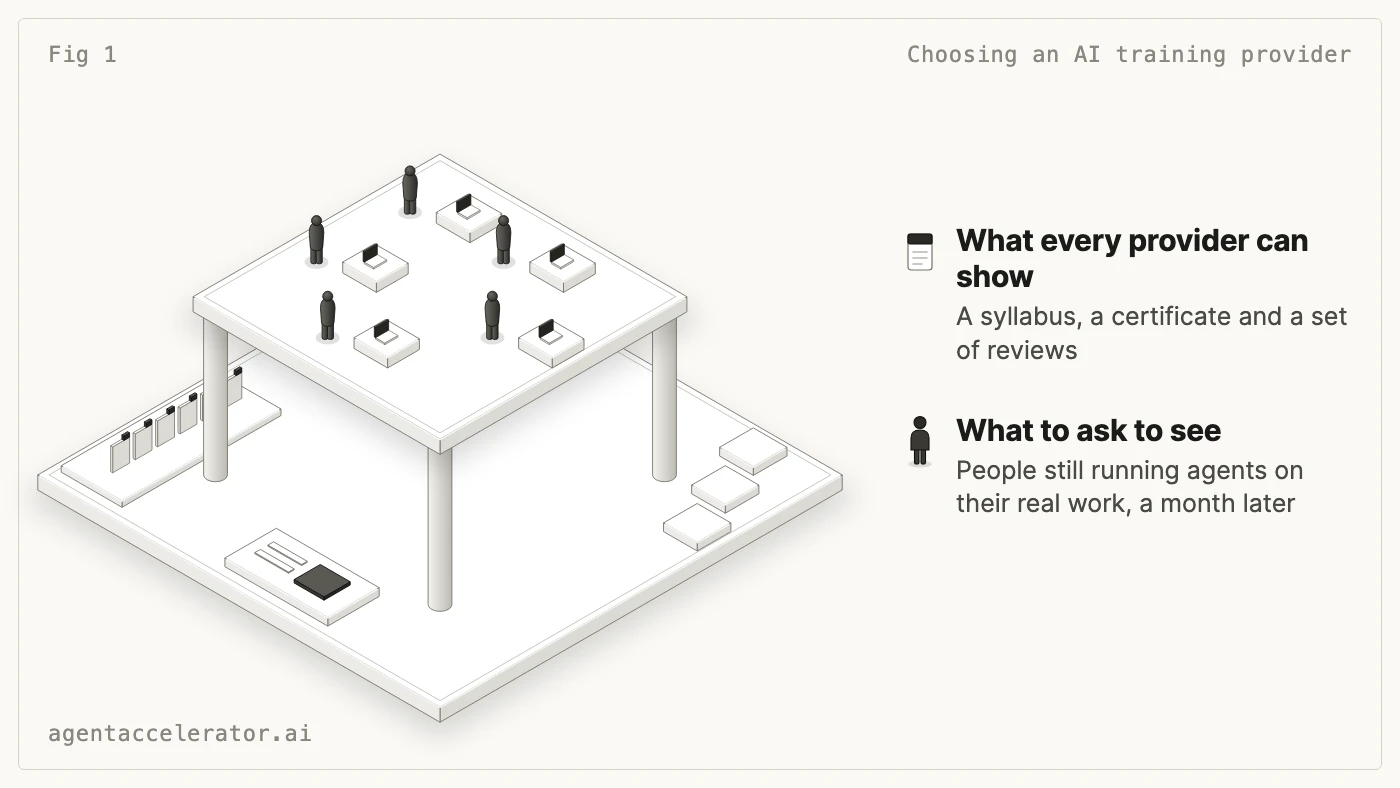
Choose the provider that can show you what its learners are still running on real work a month later. A syllabus, a certificate and good reviews tell you what was taught and whether people enjoyed it. So ask to see one person's work on their own tools, who'll be in the room, and what your team keeps when the trainer has gone.
Every provider can send you a good syllabus, so the syllabus won't separate them. Six plain questions will, and you can ask them before you sign.
Why do so few companies get past the early stages of AI?
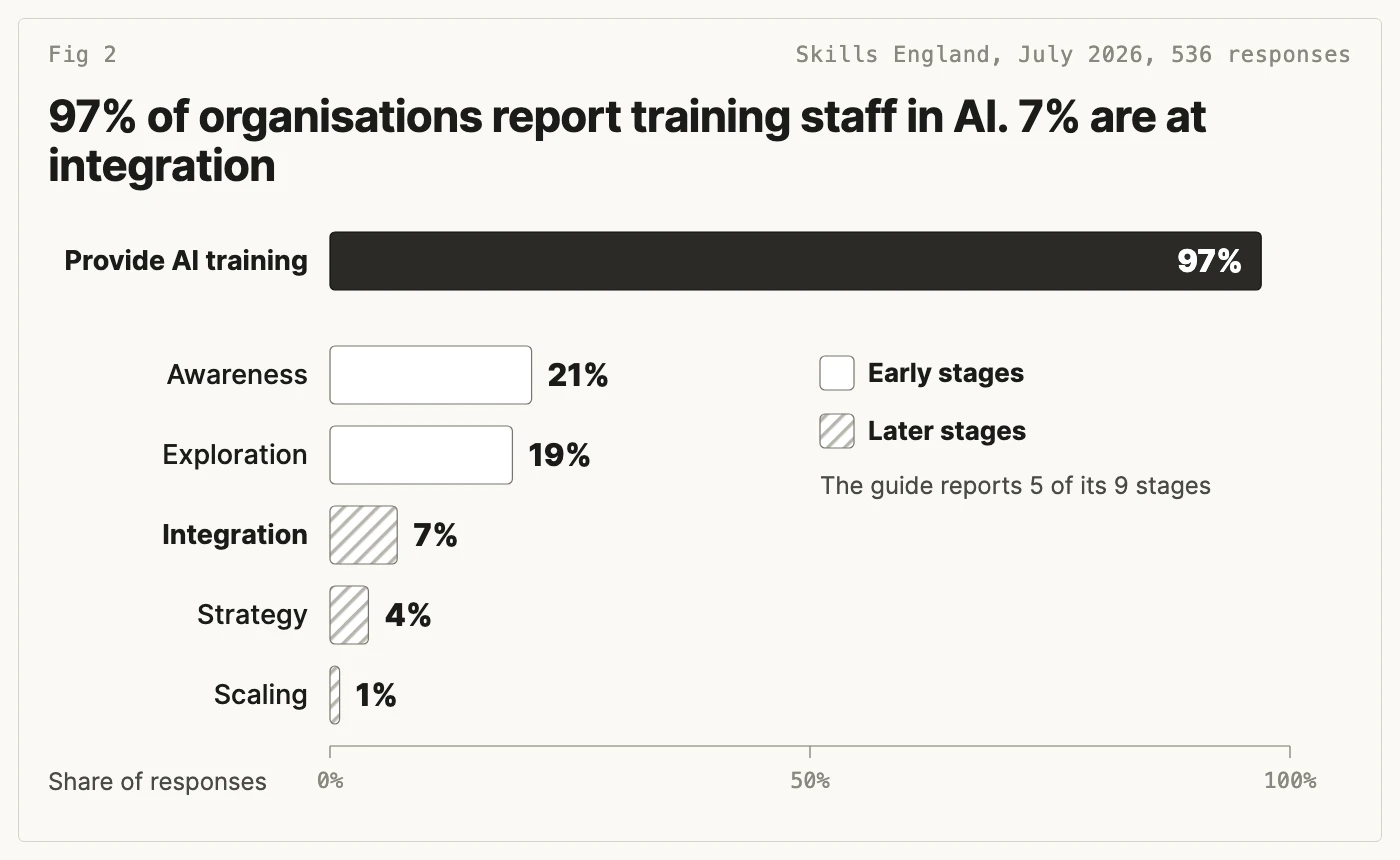
Paying for training isn't what's holding companies back. In Skills England's July 2026 guide, built on a survey of 536 responses, 97% of organisations report providing AI training. The guide gives figures for five of its nine stages: 21% at awareness and 19% at exploration, then just 7% at integration, 4% at strategy and 1% at scaling.
Licences don't settle it either. A Microsoft-led study gave Copilot to workers at 66 large firms, and 91% tried it within six months. The average worker then used it in 41% of weeks, ranging from 6.3% at the lowest-use firm to 75% at the highest. Every firm had the same tool.
The sticking point is usually getting an agent to work on your own tasks, with nobody to ask when it goes wrong. So what you're buying is a change in what people do on an ordinary Tuesday.
Which six questions should you ask an AI training provider?
Put these to every provider on your list, including James McAulay, who runs Agent Accelerator.
| Ask | What to listen for |
|---|---|
| What are your learners still running a month later? | A named, non-technical person's agent, shown to you, with the job it does and the data it runs on. Be wary of a usage percentage, a 30-day survey or a satisfaction score. |
| What will each person work on? | A task from their own week, on their own tools, agreed in an intake before the day. Be wary of a prepared case study or made-up data. |
| How much of the day is spent building? | Most of it, ending with people showing the room what they made. Be wary of slides with a demo at the end. |
| Who'll be in the room, and do they use agents in their own work? | A named trainer who can show you what they run. Be wary of "our team of trainers", or someone you haven't met. |
| Which tools will you use? | The ones you already pay for, such as Claude, ChatGPT or Copilot. Be wary of a platform your company doesn't use. |
| What do we keep, and who helps when something breaks? | A written plan for what to build next, and a named person to ask. Be wary of a slide deck and a recording. |
Push hardest on the first one. A percentage tells you people logged in. A person's own work tells you what changed, and you can ask them about it.
Hours and in-person time show up in the research too. BCG's 2025 survey of more than 10,600 people across 11 countries and regions found regular use is "sharply higher for employees that receive at least five hours of training and have access to in-person training and coaching".
A company that runs on Claude should ask one more: can you teach Claude and Claude Code to people who don't write code? Claude training for teams shows what James does there.
What does good evidence look like at four weeks, six weeks and six months?
Ask for the oldest results a provider can show you, and check that you can see who did what.
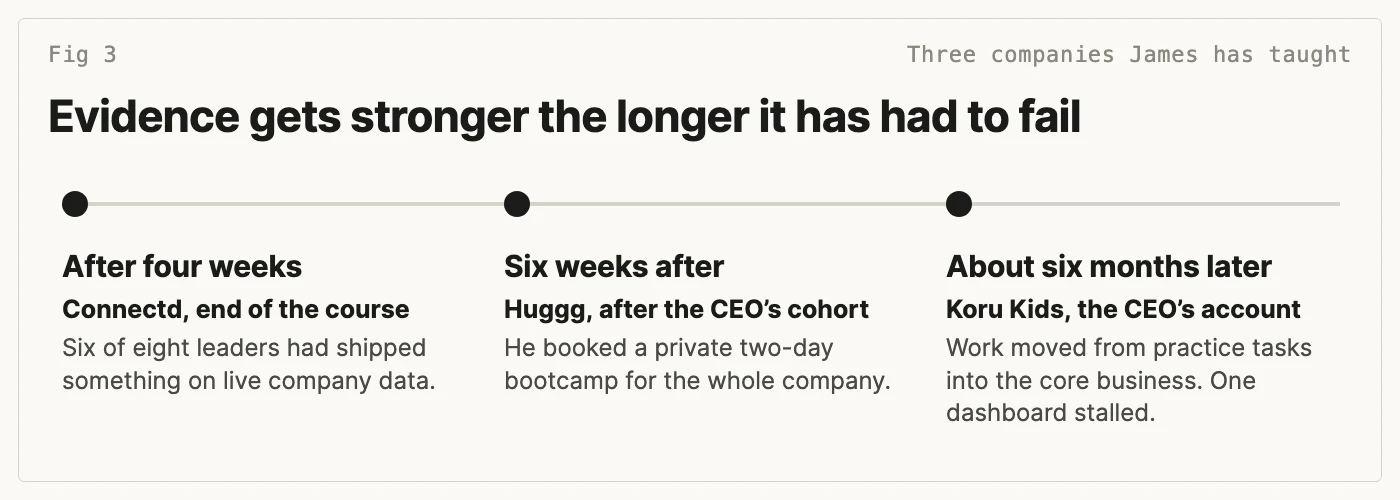
At the end of the course, look for shipped work. Connectd, a 150-person company, had "adopted basic AI fast and then stopped progressing" before eight of its leaders, CEO included, went through the four weeks. By the end, six of the eight had shipped something running against live company data, backed by 65 approved checkpoint submissions, each with a screenshot.
A few weeks on, look at what the buyer did next. Paul Wickers, CEO of Huggg, joined a cohort on his own, and six weeks after finishing he booked a private two-day bootcamp for the whole company. A CEO spending again is hard to fake.
At that bootcamp, Mustafa, an account executive, said: "it's like I've got my own sales assistant working alongside me who is integrated to my Gmail, to my HubSpot, to my Slack, to my calendar."
Months later, look for work that's moved into the business. Rachel Carrell, CEO of Koru Kids, describes going "from little toy things, which were what we were practising while we were on the course" to "things that are much more fundamental and intertwined with our core business".
Ask what stalled too, and why. A provider who stayed close will know. At Koru Kids it was the finance lead's unit-economics dashboard: "Stalled because the data pipelines weren't ready for it".
What does a certificate or accreditation tell you?
Each one answers a narrower question than whether your team will use what it learned.
| What you're shown | What it tells you |
|---|---|
| An Ofsted grade | How a publicly funded provider, such as an apprenticeship provider, was inspected |
| A UK provider number (UKPRN) | The provider is registered and verified. The register says this "does not represent quality assurance or accreditation of a provider's learning provision from the Department for Education" |
| CPD certification | The learning materials were "successfully reviewed and approved" against a checklist by a certifying body's assessors |
| A certificate of completion | Whatever people had to do to earn it, so ask what that was |
If you're buying an apprenticeship, Ofsted's grade is the right place to start. If you're regulated, ask your compliance lead what records of training you need, and ask the provider for those on top of the evidence above.
Which data rules should you set before anyone connects a tool?
Decide three things before the provider arrives: which tools are approved, what stays out of them, and who checks what people build. Real data is what makes a session useful, so people need those answers on day one.
Skills England says baseline training should be mandatory before staff use workplace AI tools "particularly where AI use involves organisational data, confidential information, regulated activity, safety, or professional judgement". Where personal data is involved, the ICO says organisations "must check that the outputs are accurate" and that privacy notices "should be updated" to say how an AI tool is being used.
Then ask the provider how the session connects to your systems. James starts everyone read-only, so early mistakes are cheap.
Why should your leaders go first?
Most companies roll out AI from the bottom: licences for everyone, a lunch-and-learn, a Slack channel for tips. A few people take off. Most wait to be told what it's for, by leaders who haven't used it on real work.
Skills England's list of gaps includes "weak leadership or organisational buy-in (22%)", and a leader who has used an agent on their own week can answer the questions a team asks.
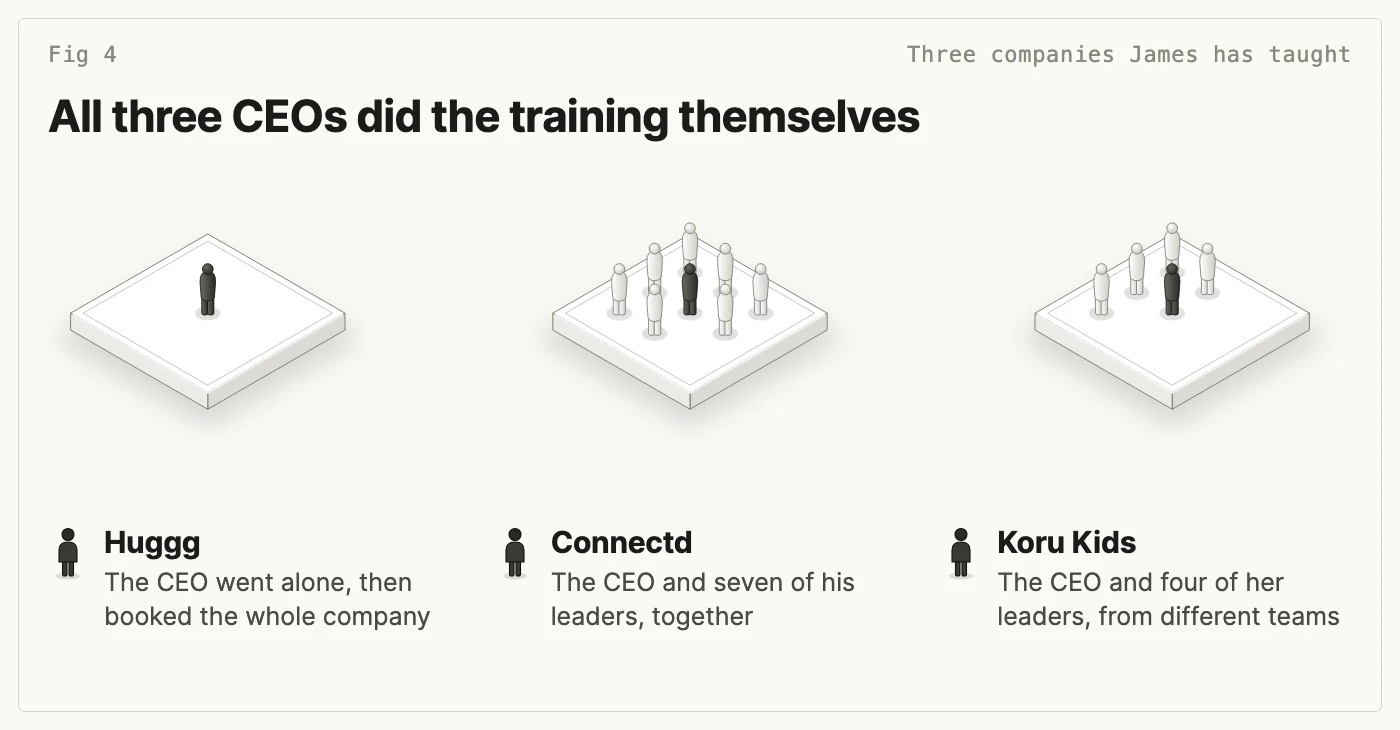
Paul Wickers went alone, before asking his team to change how they worked. Roei Samuel at Connectd took seven of his leaders, three hours on a Tuesday, three on a Friday and one on a Thursday, for four weeks.
His reason: "you have uneven skills, desire and understanding across the leadership team, it just creates uneven outcomes." Rachel Carrell took four of hers, from different parts of the business, "so that it would spread virally".
Ask the provider which of your leaders should go first, and why.
How does James answer these questions?
James has taught 700+ people from 250+ companies, and his answer to the first question is the three case studies above: what Connectd had shipped by the end of the four weeks, what Huggg's CEO did six weeks later, and where Koru Kids had got to about six months on.
He teaches every workshop himself, with a second facilitator above 30 people. Everyone picks a task from their own week and works on it in Claude, ChatGPT or Copilot, and the day closes with everyone showing the room what they've built. Everyone leaves with agents getting work done for them, and the team gets a written roadmap of what to build next. There's a certificate of completion as well, and CPD accreditation for the one-day workshop is in progress.
Team workshops run from half a day to two days, for 10 to 200 people. James quotes after a 20-minute scoping call. UK companies can see how that runs at their office, and leadership teams have their own format.
Tagged: ai-training, choosing-a-provider, team-training